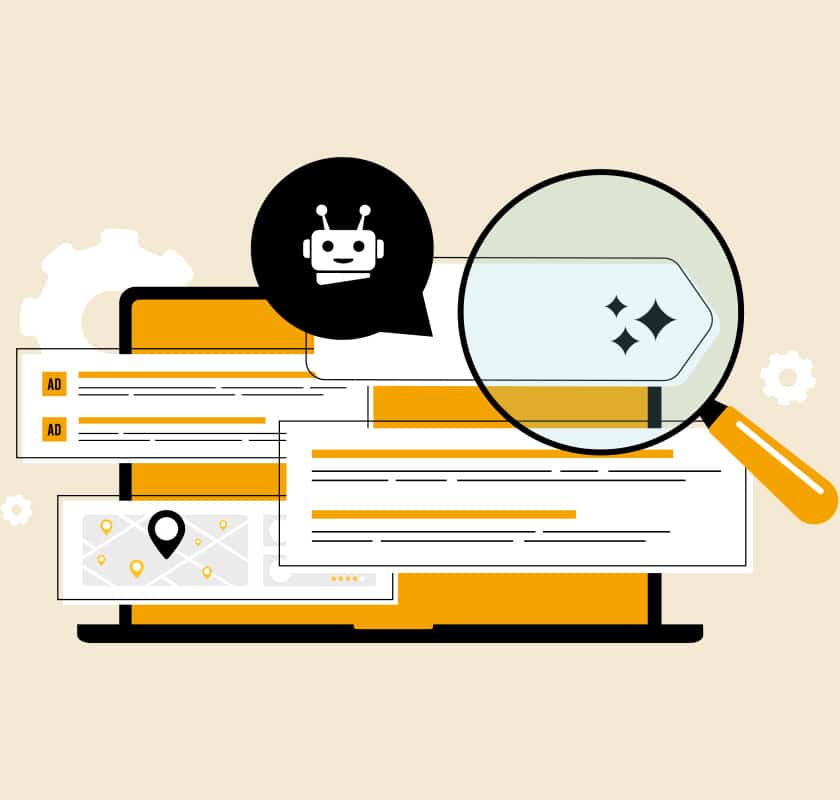

Why AI Search Is Creating “Dual-Layer” Websites
Over the past decade, website optimization has revolved around one primary audience: Google’s traditional search crawler. We structured our content around keywords, metadata, semantic hierarchy, and mobile performance—all to help Google understand what our websites were about.
But in 2024–2025, something fundamental changed. Search engines didn’t just crawl our content. They summarized it.
AI-generated overviews (Google AI Overviews, Bing Deep Search summaries, Perplexity’s page syntheses, etc.) now sit directly at the top of results pages. And for the first time ever:
Your content is being rewritten before the user even sees your website.
This shift has quietly created a new reality for digital strategy:
Every website now effectively exists in two versions:
- A text-first, AI-readable version written for crawlers and machine reasoning
- A visual-first, human-readable version designed for user experience and brand engagement
This is fundamentally changing how we design websites.
Why AI Summaries Changed Everything
Google’s AI crawlers don’t see your site the way users do.
They don’t see your colour palette, your layout, your icons, or your brand story.
They don’t “get” the emotional experience behind your hero banner.
Instead, they scan for:
- Well-structured, explicit answers
- Clear headings
- Clean semantic markup
- Lists and summaries
- Internal logic
- Authority signals
- Trust indicators
- Language consistency
- Topic coverage
AI wants to extract meaning—not admire design.
So while your website may look beautiful and intentional to a human visitor, an AI crawler could interpret it very differently. And if the crawler doesn’t understand the context, the summary it produces will be incomplete—or worse, misleading.
The Emergence of the Dual-Layer Website
Websites in 2025 now must operate on two layers simultaneously:
1. The Human Layer (Visual Experience)
This is your actual site:
- Beautiful layouts
- Persuasive design
- Imagery, video, graphics
- Brand-driven storytelling
- Interactive components
- Emotional resonance
- UX micro-interactions
This layer is all about building trust, guiding behaviour, and creating a memorable brand experience.
2. The AI Layer (Semantic Experience)
This is the version of your site the user never sees, but the crawler does:
- Text clarity
- Explicit explanations
- Strong semantic HTML
- FAQ-style answers
- Meaningful headings
- Structured data (schema)
- Internal linking logic
- Crawlable summaries
- Clear definitions and statements
- High-quality authoritative text
This layer is not “marketing fluff”—it’s your knowledge graph.
Google’s AI models are trying to understand your expertise, not your aesthetics.
Why Both Layers Matter Now
AI-generated summaries often appear before organic results.
That means:
If AI doesn’t understand you, it won’t recommend you.
Even if your site is gorgeous.
The risk?
Your competitors with better-written text content—not necessarily better websites—will be the ones cited in AI Overviews.
Problems We’re Already Seeing
Here are a few patterns emerging across industries:
1. Beautiful sites with poor semantic structure being ignored by AI
Even high-budget corporate sites are failing to get mentioned in summaries because their content isn’t explicit enough.
2. Sites overly reliant on visuals
Minimalist sites, content-light designs, and heavy visual structures often leave no text for AI to interpret.
3. AI hallucinating or misrepresenting brands
If your website’s text is sparse or unclear, AI tries to infer missing details—sometimes incorrectly.
4. Organizations accidentally teaching AI the wrong message
If your most detailed content is buried in an old blog post or PDF, AI may pull that as your main narrative, not your polished homepage.
So How Do You Optimize for Both Humans and AI?
1. Write clear, authoritative text—then design visually around it.
Stop burying meaning inside graphics or sliders.
AI can’t interpret your Canva image banner.
2. Use semantic HTML like your ranking depends on it (because it does).
Your < h1 >,< /h1 >, < h2 >,< /h2 >, < strong > and list structure must be logical and crawlable.
3. Provide explicit answers on every major page.
If you’re a nonprofit, don’t imply your impact—state it.
If you offer services, state:
- what you do
- who it’s for
- why it matters
- how you deliver it
- No ambiguity.
4. Add structured data (schema) everywhere.
This is how you speak AI’s native language—by giving search engines a clear, machine-readable explanation of what your content means, not just what it says.
What is schema?
Schema (also called structured data) is a standardized vocabulary that helps search engines understand your website’s content at a deeper, contextual level. Instead of simply crawling your text, schema tells Google exactly what each element represents—whether it’s an organization, a service, a product, a team member, an FAQ, or a blog article.
How is schema added?
Schema is usually added in the form of JSON-LD code, placed in the < head > of a webpage. Modern website builders and plugins can generate it automatically, or developers can write it manually based on Google’s schema guidelines.
Types to use across your site:
Organization schema – communicates who you are, what you do, and key business details
- FAQ schema – highlights questions and answers for AI summaries
- Service schema – defines each service you offer with clear descriptions
- Product schema – useful if you have donation forms, ticketing, or e-commerce
- Article schema – boosts visibility of blogs and resource content
By implementing schema consistently, you ensure that AI crawlers fully understand your expertise—and surface it accurately in AI-generated summaries.
5. Create AI-Friendly Content Blocks
Think:
- TL;DR summaries (short, condensed versions of a longer piece of content that highlight only the most essential information. The term stands for “Too Long; Didn’t Read.)
- FAQ blocks
- “What this means” explanations
- Bullet lists
- Step-by-step sections
These chunks are easy for models to extract and use in summaries.
6. Build a strong internal linking map
AI uses links to understand topical relationships.
This is where many sites fail today.
7. Keep humans first—because AI summaries drive users to your site
Your SEO gets them interested.
Your design gets them to trust you and convert.
Both matter.
Final Thoughts
Search used to be simple: write good content + optimize it.
Now it’s dual-layer:
- One layer feeds AI models
- One layer engages humans
The brands that win in 2025 and beyond will be the ones who deliberately design for both.
Not every agency has caught up to this reality yet—but those who do will quietly dominate the next era of search.